
Tag: Kenya
-

BBC: ‘Good vibration’ hand pumps boost Africa’s water security
By Matt McGrath Environment correspondent Published: http://www.bbc.com/news/science-environment-39077761 The simple up-and-down motion of hand pumps could help scientists secure a key water source for 200 million people in Africa. Growing demand for groundwater is putting pressure on the resource while researchers struggle to accurately estimate the future supply. But a team from Oxford University says that low-cost…
-

How far has devolution come in Kenya?
There is more to UPGro than rocks… for groundwater to benefit the poor, African governments need evolve and improve. Johanna Koehler, a doctoral researcher at Oxford University (Gro for GooD), reports on her experiences last year with Kenya at The Third Annual Devolution Conference, Meru, Kenya, April 2016 Devolution is here to last! This message…
-

Looking back: 2016 Kenya fieldwork
from Gro for Good newsletter 2 A comprehensive and efficient environmental monitoring network has been set up for the study area collecting relevant, timely and cost-effective data on rainfall, river flow and groundwater level and recharge. Data will be used in the development and running of a Groundwater Risk Management Tool, which will include a…
-
Policy: Devolution & Water Services in Kenya
from Gro for GooD newsletter 2 Johanna Koehler, Gro for GooD researcher (University of Oxford) reports from Kenya’s Third Annual Devolution Conference, April 2016 Devolution is here to last! This message was delivered loud and clear at the Third Annual Devolution Conference in Kenya, organised by the Council of Governors. In three years this conference…
-
Field update from Kenya
by Prof. Dan Olago, University of Nairobi in Gro for Good newsletter 2 2016 Welcome to the second edition of our project newsletter. There has been a lot of activity in recent months including: the completion of the installation and commissioning of the climate and hydrological monitoring network; two groundwater sampling campaigns in March and June; geophysical…
-

This is why there is a handpump in the car park – and what it has in common with a jet engine
On 17th September, the mystery surrounding the Samrat handpump which has been installed in the car park of Oxford University’s School of Geography and the Environment was revealed. Learn more about the pump’s research purpose at www.oxwater.uk/oxford-smart-handpump.html or download the presentation below. handpumpcarpark_17oct2016_final
-

The Smart Handpump comes to Oxford
from: http://www.geog.ox.ac.uk/news/articles/160526-smart-handpump.html The ‘Smart Handpump’ was developed in 2011 by a team at Oxford University with a field-ready prototype starting operational trials in Kenya in 2012. These trials demonstrated proof-of-concept for remote monitoring of handpumps using simple microprocessor, accelerometer and global system for mobile communications (GSM) components. Smart Handpumps provide hourly data related to pump usage,…
-
Securing safe water through Cloud Computing
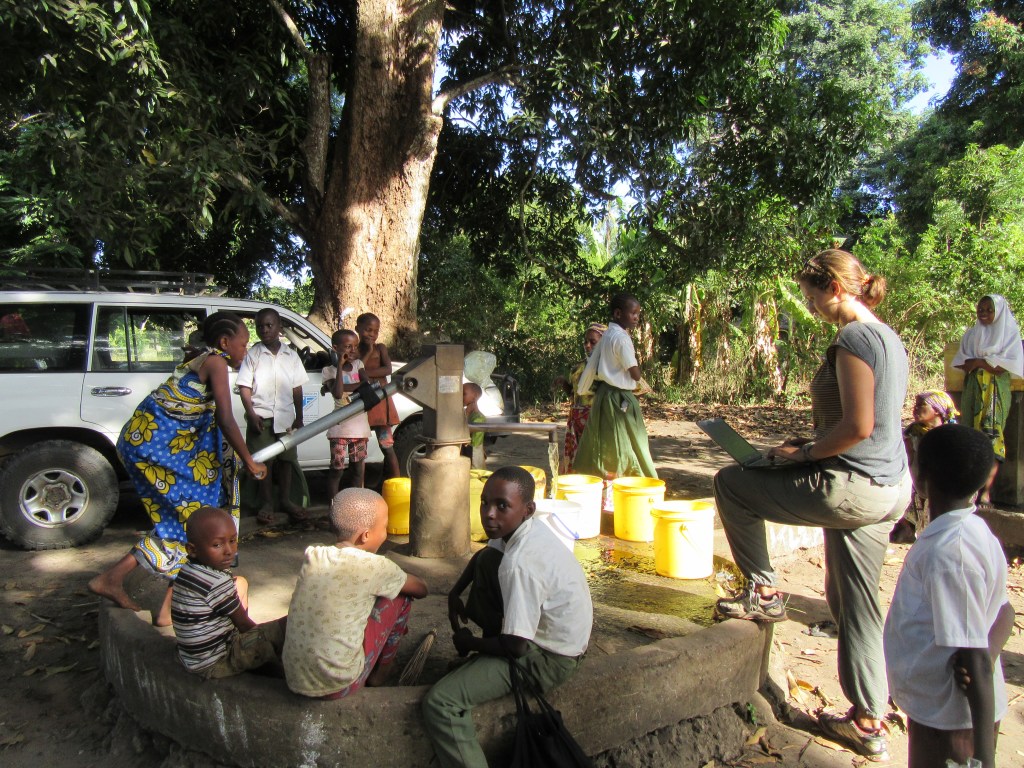
reblogged from the Microsoft Research blog Kenji Takeda, Solution Architect and Technical Manager, Microsoft Research Jacob Katuva used to get up at dawn to cycle 12 miles from his village to collect water with his uncles and cousins when he was growing up in Kenya. Now he is part of a research team at Oxford…
-

Can a rural handpump tell you it’s not well?
Heloise Greeff, Doctoral Researcher, Water Programme, Computational Health Informatics Lab and Smith School of Enterprise and the Environment, University of Oxford Predictive health monitoring is widely used in engineering applications to detect damage to infrastructure as early as possible. Forecasting failure rather than merely detecting failure once it occurs helps to reduce the downtime of…
-
How do you solve a problem like a broken water pump?
World Water Day 2016 article on The Guardian by Katherine Purvis, 22/03/2016 Long considered a symbol of development aid, up to 40% of handpumps in sub-Saharan Africa are broken at any one time. Technology is offering smart solutions. Over the past few decades, the humble handpump has become the go-to option for rural water supply…
 UPGro
UPGro 