
Author: RWSN Secretariat
-

Championing environmental sustainability in Malawi schools: inspiring the next generation
In March 2018 a team of motivated scientists from ‘Malawi Girls in Science, Technology, Engineering and Mathematics’ (MAGSTEM) at Chancellor College, a scholar from the Grantham Centre for Sustainable Futures (University of Sheffield) facilitated by an UPGro researcher teamed up to reach out to disadvantaged schools in Zomba, Malawi.
-

Sharing experiences of data flows in water and sanitation – some reflections from AGUASAN Workshop 2018
by Sean Furey, Skat Foundation / UPGro Knowledge Broker Team AGUASAN Workshop: “Leveraging the data revolution Informed decision-making for better water and sanitation management” June 25th to 29th 2018, Spiez, Switzerland AGUASAN is the Swiss Community of Practice for water and sanitation that has been running since 1984 and comprises regular meetings through the year…
-
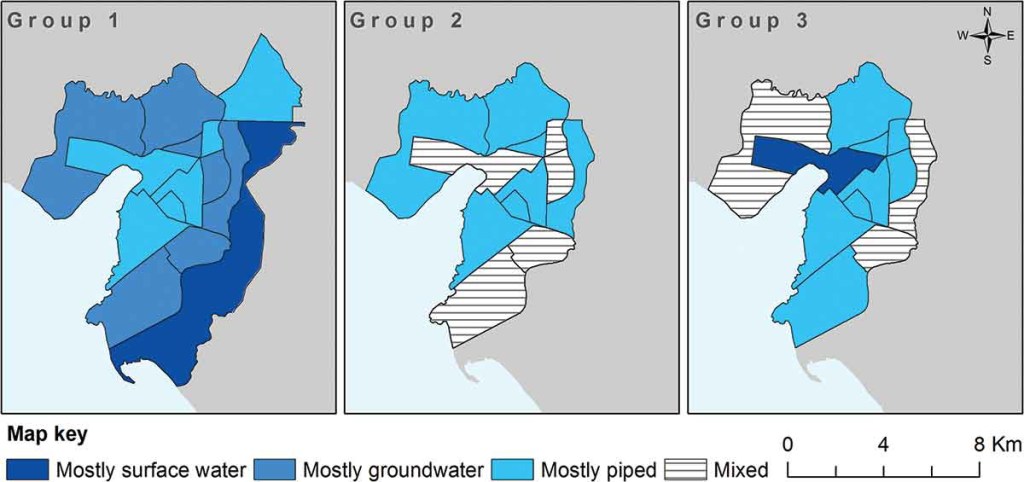
:: New UPGro paper :: Participatory scenario analysis for urban water and sanitation: Kisumu, Kenya case study
“A participatory methodology for future scenario analysis of sub-national water and sanitation access: case study of Kisumu, Kenya” by Heather Price, Lorna. G. Okotto, Joseph Okotto-Okotto, Steve Pedley & Jim Wright: https://doi.org/10.1080/02508060.2018.1500343 from the UPGro Catalyst Project “Sustaining groundwater safety in peri-urban areas” Context: Many cities in Sub-Saharan Africa, and other low and middle income…
-

:: New UPGro Paper :: Tryptophan-like fluorescence as a measure of microbial contamination
A new paper has been published from the UPGro Gro for GooD project, working in Kenya, which develops the work done under the UPGro Catalyst Project on mapping groundwater quality, which developed an exciting new low-cost, real-time method of measuring microbial contamination of groundwater. Context: Globally, 25% of people lack access to water that is…
-

Arena meeting participants visited a number of informal settlements in Arusha (Tanzania)
re-posted from Tgroups.science On May 30, 2018, the participants of the Transition Management process, multiple actors active in different organisations and sectors such as the government, NGOs and the University, visited different informal settlements in Arusha with the aim to learn about local challenges and opportunities (e.g. innovative projects and initiatives).
-

The Baseflow Detective looking to uncover the secrets of Tanzania’s rivers
Interview with Hezron Philipo, GroFutures by Sean Furey, Skat Foundation Hezron Philipo has a BSc in Geology (University of Dar es Salaam, Tanzania), MSc in Water Resources and Environmental Management (University of Twente at ITC, The Netherlands) and is currently doing his PhD research at Sokoine University of Agriculture in Tanzania as part of the…
-
How is the Transition Management approach applied in Dodowa peri-urban area? Have a look at these short videos!
Re-posted from T-Group.science The first video shows a number of insights and key moments from the first Transition Management arena meeting organised by the local transition team. Participants first reflected on and discussed the main problems affecting their communities. Their inputs were collected and problems were prioritized. In the majority of the meetings, inadequate sanitation…
-
How are multiple actors identifying and discussing the main problems affecting their community? Insights from the Transition Management process in Kawala community, Kampala (Uganda)
Sixteen participants belonging to Kawaala community participated in the first Transition Management arena with the aim to define the most urgent and priority problems in their communities. The participants arrived on time and shared since the beginning of the meeting their motivation to participate. Most of the participants already knew the T-GroUP research team since…
-

A Malawian researcher takes UPGro knowledge to up-and-coming scientists in college
Interview by Isaiah Esipisu, PAMACC News Agency – www.pamacc.org Patrick Makuluni is a lecturer in the Mining Department of the University of Malawi, the Polytechnic. Makuluni holds MSc in Mineral Exploration and Mining Geology from Curtin University in Australia and BSc in Civil Engineering from University of Malawi, the Polytechnic. Recently, the scientist published a…
-

Gro for GooD “Smart Handpumps” wins Oxford University Vice-Chancellor’s Award
From: www.ox.ac.uk/research/vice-chancellors-innovation-awards The Vice-Chancellor’s Innovation Awards seek to recognise and celebrate exceptional research-led innovations and products at all University levels that are having societal or economic impact. The initiative attracted a total of 78 entries, from which four winners were chosen and a further 13 projects highly commended across four categories: team work, building capacity,…
 UPGro
UPGro 